
Extending Infrastructure Lifecycles in a High-Cost Memory Market
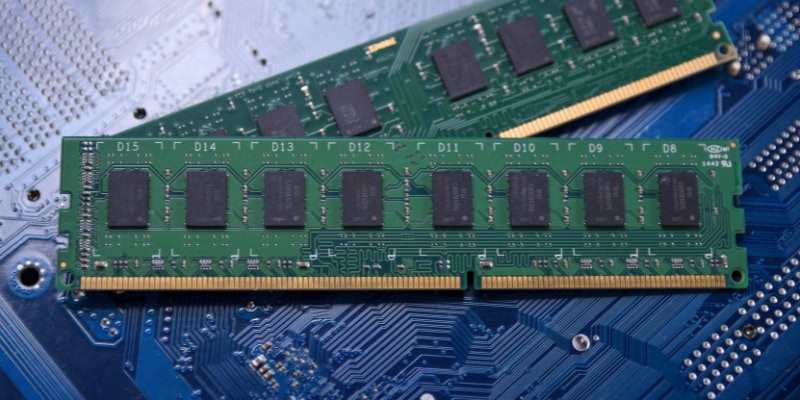
Rising DDR4 pricing has fundamentally changed upgrade economics.
For infrastructure operations managers, IT asset managers, and sustainability leaders, the decision to extend server lifespan is no longer tactical. It is strategic.
Lifecycle extension can reduce immediate capital outlay. But done improperly, it increases operational risk, weakens governance, and undermines sustainability goals.
The organizations that succeed in a high-cost memory market apply structured IT lifecycle management. They quantify trade-offs, control risk, and align cost optimization with sustainability and compliance.
This article provides a disciplined operational framework to evaluate when and how to extend infrastructure responsibly.
The Financial Impact of Rising Memory Costs
When server memory costs increase, the economics of upgrade and refresh shift.
Historically, refresh decisions followed predictable patterns:
- Component pricing declined over time.
- Maintenance costs rose gradually.
- Replacement followed established depreciation cycles.
In a high-cost memory environment, those assumptions weaken.
Organizations must now evaluate three financial variables simultaneously:
- Incremental upgrade cost (e.g., memory expansion)
- Extended maintenance and support costs
- Full replacement capital expenditure
Lifecycle extension makes financial sense only when:
- The cost of sustaining performance is materially lower than replacement.
- Failure risk remains within defined operational thresholds.
- Supportability can be maintained without disproportionate escalation.
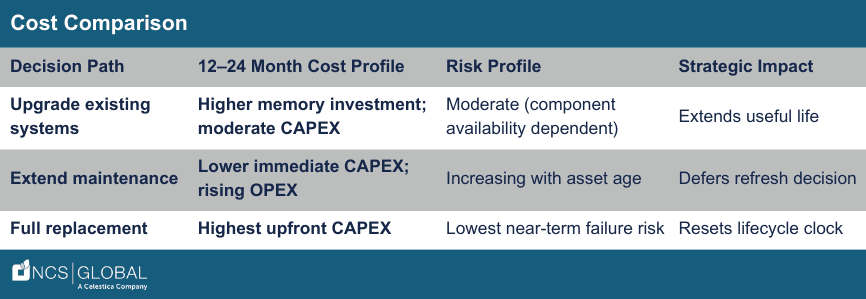
The critical shift is that lifecycle extension must now be evaluated as a structured cost optimization strategy, not a temporary delay tactic.
Repair, Redeploy, or Retire: A Decision Framework
Extending server lifespan requires disciplined governance. Ad hoc decisions create risk accumulation.
A rigorous framework includes defined inflection points.
1. Define Performance Thresholds
- Are workloads exceeding 70–80% sustained utilization?
- Are latency or throughput metrics degrading?
- Are software requirements outpacing hardware capability?
If performance gaps require disproportionate investment, extension may not be viable.
2. Assess Supportability and Component Risk
- Are replacement components increasingly scarce?
- Is manufacturer support expiring or already expired?
- Are repair timelines extending beyond acceptable operational windows?
When support friction increases materially, risk escalates.
3. Model Total Cost of Extension
Evaluate:
- Memory upgrade cost versus full replacement
- Incremental energy consumption
- Maintenance contract adjustments
- Risk-adjusted failure cost
Extension is financially justified only when the total cost of continued operation remains materially below replacement, with controlled exposure.
4. Enable Secure Redeployment
Hardware redeployment can optimize asset value, but only when certified data eradication processes are in place.
Without documented, verifiable data sanitization, redeployment introduces regulatory, contractual, and reputational risks.
Secure lifecycle extension requires:
- Chain-of-custody documentation
- Auditable data destruction standards
Compliance-aligned governance controls
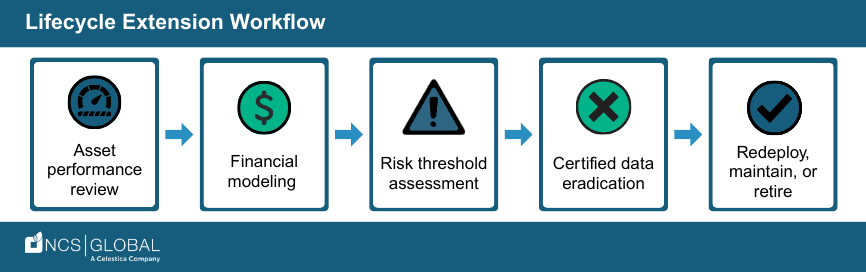
This workflow must be repeatable, measurable, and defensible.
Risk Controls for Extended Infrastructure
Lifecycle extension increases exposure if unmanaged, but mature IT lifecycle management introduces guardrails.
Key risk controls include:
- Defined maximum asset age thresholds
- Spare inventory strategies aligned to failure probability
- Performance monitoring tied to predefined exit triggers
- Formal quarterly lifecycle review checkpoints
Organizations should explicitly define:
- Maximum acceptable downtime per asset class
- Acceptable repair turnaround time
- Escalation triggers that initiate replacement planning
Extension without these controls shifts from optimization to unmanaged risk, but disciplined governance protects both operational continuity and financial outcomes.
Aligning Lifecycle Extension with Sustainability Goals
Extending server lifespan can meaningfully support sustainability objectives:
- Reduced e-waste generation
- Maximized use of embodied carbon
- Improved asset utilization rates
However, sustainability must be evaluated holistically.
Older systems may:
- Consume more energy
- Lack modern efficiency optimizations
- Increase cooling demand
A balanced strategy integrates:
- Financial modeling
- Operational reliability metrics
- Environmental impact assessment

Sustainable IT infrastructure is not defined by extending assets indefinitely. It is defined by extending them responsibly with measurable governance and controlled risk.
From Cost Pressure to Lifecycle Discipline
Rising memory prices have made lifecycle extension a strategic lever, but extension without structure creates hidden liabilities.
Effective infrastructure cost optimization requires:
- Comprehensive asset visibility
- Scenario-based financial modeling
- Formalized risk thresholds
- Certified data eradication and redeployment processes
- Sustainability alignment embedded into lifecycle policy
NCS Global helps organizations implement structured IT lifecycle management frameworks that align cost control, operational integrity, and environmental responsibility. As a Celestica company, NCS Global combines lifecycle expertise with global operational scale and disciplined execution, enabling enterprises to extend server lifespan with governance, compliance, and supply chain visibility built in.
In a high-cost memory market, the advantage lies with organizations that treat lifecycle extension as a strategic approach rather than a reactive response.
If you are evaluating how to extend infrastructure life while protecting performance, compliance, and sustainability goals, contact NCS Global to develop a disciplined lifecycle management approach aligned to today’s market realities.