Top 5 ITAD Trends for 2026

IT asset disposition (ITAD) is no longer a peripheral process. It’s a strategic function that touches every aspect of operations, from finance and procurement to ESG reporting and data compliance.
As we move into 2026, the landscape is shifting rapidly. Enterprise adoption of AI is accelerating hardware turnover. Regulatory bodies are enforcing carbon disclosures. Procurement models now embed ITAD clauses, and finance teams are prioritizing value recovery like never before.
How your organization handles end-of-life IT equipment is no longer just a technical concern. It’s a reflection of your compliance posture, your sustainability commitments, and your ability to extract value from every investment.
In this blog, we explore the five biggest ITAD trends that will define 2026 and how NCS Global is helping enterprise teams stay ahead with secure, sustainable, and ROI-driven solutions.
1. AI Adoption Is Accelerating Hardware Refresh Cycles
As artificial intelligence becomes central to enterprise operations, IT teams are racing to deploy more powerful hardware and cycling through it at record speeds.
Traditional hardware refresh cycles averaged 3 to 5 years. But now, AI workloads are compressing that to as little as 18 to 24 months, especially for high-performance computing devices like GPUs, AI accelerators, and storage servers.
Why it matters:
- Faster turnover = more decommissioned assets.
- More devices = greater security, compliance, and logistics complexity.
- Organizations can no longer rely on one-off ITAD projects or slow, manual tracking to keep pace.
The opportunity:
Companies that proactively align their ITAD strategy with the pace of AI-driven infrastructure shifts can avoid security risks, reduce downtime, and recover maximum value.
At NCS Global, we:
- Enable scalable, rapid ITAD workflows tailored to high-volume, high-performance asset environments.
- Provide secure, certified data erasure with our proprietary EcoErase™ software, customizable for different use cases and wipe cycles.
- Deliver value recovery through resale, reuse, or environmentally responsible recycling.
2. ESG and Carbon Reporting Are Reshaping ITAD Requirements
In 2026, ITAD will be under intense scrutiny—not just from the CIO or IT manager, but from legal, finance, and sustainability teams. ESG has evolved from a voluntary framework to a compliance requirement in many jurisdictions.
Mandates such as the U.S. SEC’s climate disclosure rules and the EU’s Corporate Sustainability Reporting Directive (CSRD) are pushing companies to quantify and disclose the environmental impact of all operations, including IT hardware use and disposal.
Why it matters:
- Companies must report on Scope 3 emissions, which include hardware manufacturing, use, and end-of-life impact.
- ITAD practices such as recycling, reuse, and landfill avoidance are now material to ESG audits.
- Without verifiable data, enterprises risk fines, audit failure, or reputational damage.
The opportunity:
Enterprises that partner with ITAD vendors offering certified environmental reporting and carbon offset data gain an edge in both compliance and brand trust.
At NCS Global, our ITAD solutions include:
- Certified reuse and recycling metrics tied to ESG reporting standards.
- Documentation that supports carbon footprint assessments and emissions tracking.
- Secure logistics and reporting for compliance with e-waste regulations, including WEEE and EPA standards.
3. Reverse Logistics and DaaS Are Embedding ITAD Into Procurement
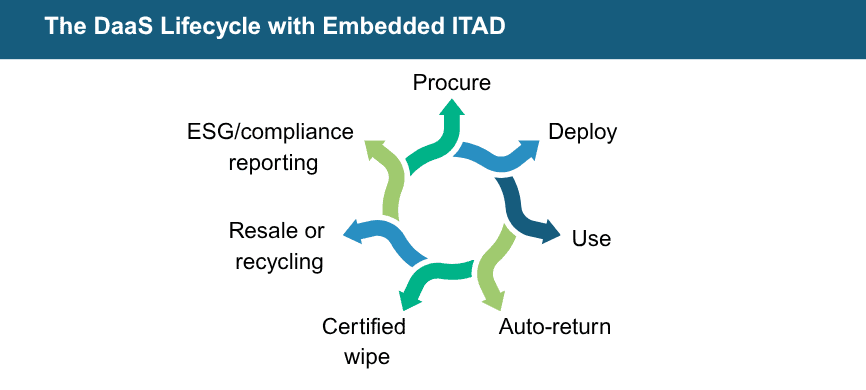
Traditional procurement is giving way to subscription-based IT models, including Device-as-a-Service (DaaS), where assets are leased or managed through full-lifecycle agreements. This shift is dramatically changing how ITAD is executed.
In these models, contracts increasingly include built-in return and disposition clauses, requiring organizations to:
- Return devices at regular intervals
- Ensure secure data destruction
- Document sustainability and compliance outcomes
Why it matters:
- ITAD is no longer a reactive service. It must be embedded proactively into procurement and lifecycle planning.
- Failure to comply with embedded ITAD terms can lead to vendor penalties or SLA breaches.
The opportunity:
Companies that embed flexible, scalable reverse logistics into their procurement process avoid last-minute surprises, reduce total ownership cost, and improve resource efficiency.
NCS Global supports DaaS-aligned ITAD with:
- Contract-integrated logistics and decommissioning workflows
- Pre-scheduled return and asset pickup cycles
- Portal-based visibility and SLA tracking
4. Value Recovery Is Now a Strategic KPI for Finance Teams
As hardware refreshes accelerate and budgets tighten, finance teams are looking for ways to offset infrastructure investments. Enter value recovery.
Value recovery in ITAD refers to the ability to monetize retired assets through resale, reuse, parts harvesting, or environmentally efficient disposal.
Why it matters:
- For large enterprises, recovering just 20–40% of an asset’s residual value can represent millions in reclaimed budget.
- Finance leaders increasingly view ITAD as a cost-recovery opportunity, not just a risk mitigation expense.
The opportunity:
CFOs are now asking questions like:
- What resale value are we capturing from decommissioned assets?
- Are we documenting that recovery in our financial reports?
- Which vendors provide audit-ready resale and recycling report?
At NCS Global, we’ve made value recovery a pillar of our service:
- Our clients benefit from revenue-sharing models that reward sustainable asset reuse.
- We provide detailed reporting on recovery performance, including condition grading, market resale value, and lifecycle extension.
- We help clients make ITAD a line item for savings and sustainability, not just compliance.
5. Materials Recovery Is Gaining Ground in Circular IT
As supply chains grow more volatile and rare earth metals become more expensive, enterprises are beginning to think beyond resale.
Recovering critical materials, such as copper, palladium, lithium, and neodymium, from outdated IT assets is now part of broader circular economy strategies.
Why it matters:
- Precious metals in IT hardware are limited resources and increasingly scrutinized for ethical sourcing.
- Companies that recover and reuse materials from decommissioned assets reduce environmental impact and insulate themselves from supply chain risk.
The opportunity:
NCS Global works with clients and recovery specialists to:
- Identify eligible assets for advanced separation and materials extraction
- Track and report on resource reclamation metrics
- Integrate circularity goals into standard ITAD processes
This approach helps organizations move toward net-zero waste targets and reduce reliance on virgin raw materials.
ITAD Is a Strategic Advantage
2026 will mark a significant shift in how organizations view and execute ITAD.
Forward-thinking IT leaders know that outdated ITAD models won’t cut it, whether it’s:
- Keeping pace with AI innovation
- Meeting new ESG and carbon disclosure mandates
- Embedding ITAD into contracts and SLAs
- Recovering value from every decommissioned asset
Future-Proof Your ITAD Strategy with NCS Global
At NCS Global, we provide more than asset disposition. We deliver:
- Secure, compliant, and certified ITAD
- Sustainability reporting for ESG audits
- Value recovery and resale programs that add to your bottom line
- Scalable logistics built for AI, DaaS, and modern enterprise
Let’s build an ITAD strategy that’s ready for 2026. Contact us today to schedule a consultation or learn how our services can support your IT and sustainability goals.