
DDR4 Shortages and Rising Memory Prices: What IT Leaders Need to Know in 2026

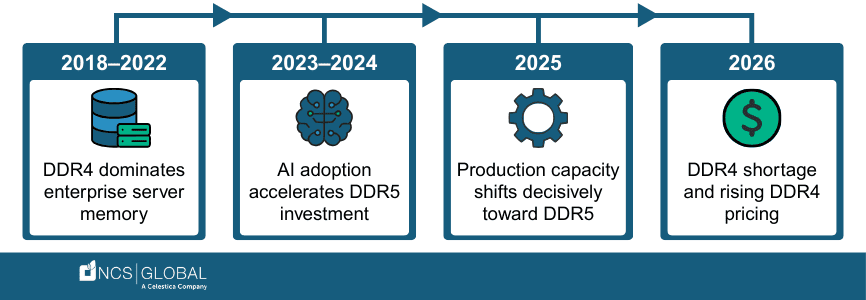
In 2026, the DDR4 shortage is not a temporary supply imbalance.
It is a structural shift in manufacturing driven by demand for AI infrastructure.
Memory manufacturers are reallocating production capacity toward DDR5 to support AI builds. As fabrication lines and capital investment shift, DDR4 supply tightens. Pricing becomes volatile. Long-standing enterprise lifecycle assumptions begin to erode.
For CIOs, infrastructure directors, procurement leaders, and data center managers, the challenge is not simply higher server memory costs. It is planning in a market that no longer behaves the way it did five years ago.
The DDR4 shortage reflects a durable market shift. Strategic infrastructure planning must adjust accordingly.
Why DDR4 Supply Has Tightened
DDR4 has been the backbone of enterprise server environments for over a decade. Its maturity delivered stable pricing, predictable procurement, and manageable refresh cycles.
That stability depended on production scale.
Today, manufacturers are reducing DDR4 output and prioritizing DDR5 fabrication to meet accelerating AI infrastructure demand. Semiconductor fabrication capacity is finite. When wafer starts are redirected to DDR5, DDR4 output declines.
This is not a cyclical dip in supply. It is a capital reallocation decision.
Key structural drivers include:
- Fabrication capacity constraints
- AI infrastructure requiring higher-bandwidth DDR5
- Investment flowing toward next-generation platforms
- Gradual wind-down of mature DDR4 production lines
When demand remains steady in enterprise environments but supply contracts, price pressure follows.
The imbalance is supply-driven, not demand-driven.
The AI-Driven Shift to DDR5 Production
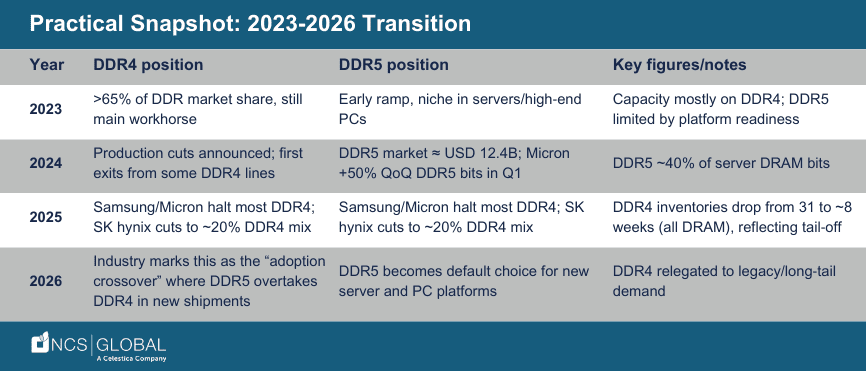
AI workloads require higher memory bandwidth and performance density. DDR5 is engineered to meet those requirements. As AI infrastructure demand grows, manufacturers prioritize DDR5 production.
The effect extends beyond technology preference. It reshapes enterprise supply dynamics.
When manufacturers retool fabrication lines, redirect capital expenditure, and allocate wafer starts toward DDR5, they implicitly reduce long-term DDR4 availability.
Enterprise buyers are now competing for DDR4 supply in a market where growth capital is no longer supporting that platform.
Unlike previous generational transitions, AI infrastructure demand compresses the timeline. Capacity moves faster. Supply tightens sooner.
For enterprises operating large DDR4-based server estates, this exposure is material.
Budget and Infrastructure Implications
As DDR4 supply contracts, DDR4 pricing becomes less predictable. That volatility affects more than procurement line items.
It affects lifecycle economics.
Enterprise planning models often assume:
- Stable component replacement costs
- Predictable lead times
- Linear depreciation schedules
When server memory costs rise unexpectedly, those assumptions weaken.
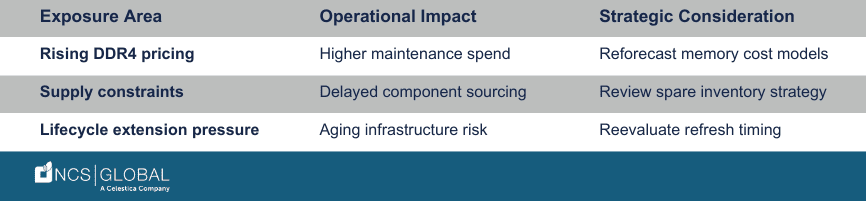
Operational and financial implications include:
- Increased OPEX for maintenance and spares
- Budget variance in infrastructure forecasting
- Greater risk during hardware failure events
- Tension between extending assets and accelerating refresh
For organizations managing global server footprints, these dynamics compound. Procurement cycles lengthen, regional supply variability increases, and budget alignment across IT and finance becomes more complex.
This is where disciplined lifecycle governance becomes critical.
Planning Strategies in a Volatile Memory Market
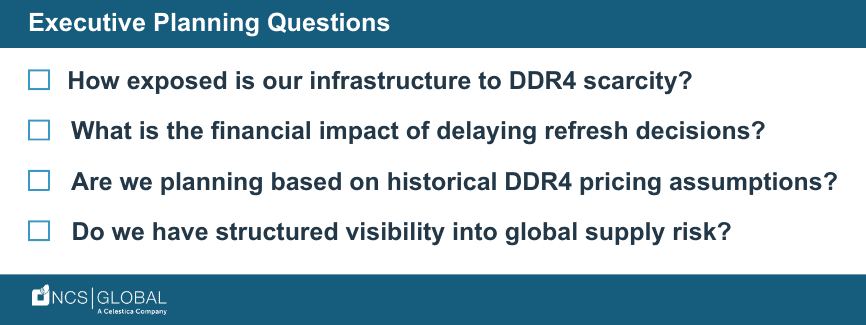
The DDR4 shortage requires structured scenario planning.
Short-term actions should include:
- Auditing installed DDR4 capacity across environments.
- Quantifying exposure to memory replacement over 12–24 months.
- Modeling sensitivity to DDR4 pricing increases.
Mid-term strategy requires clearer trade-off evaluation:
Option 1: Extend DDR4-based infrastructure.
Accept pricing volatility and potential supply constraints while maximizing asset life.
Option 2: Accelerate migration to DDR5-capable platforms.
Increase near-term CAPEX to reduce future exposure to tightening DDR4 supply.
Neither option is universally correct. The appropriate path depends on:
- Capital flexibility
- Risk tolerance
- Performance requirements
- Global supply visibility
Organizations that treat this shift as temporary may rely on reactive purchasing. Those that treat it as structural can implement disciplined lifecycle and sourcing strategies.
This is precisely where experienced infrastructure lifecycle management becomes a competitive advantage.
From Market Awareness to Strategic Execution
The DDR4 shortage is the visible symptom. The underlying cause is capital flowing toward AI-enabled DDR5 production .
For IT leaders, the response should be deliberate:
- Align procurement strategy with production reality.
- Revalidate enterprise hardware lifecycle assumptions.
- Integrate supply chain risk into infrastructure planning.
As a Celestica company, NCS Global works at the intersection of global sourcing, infrastructure lifecycle management, and cost optimization. In a market defined by tightening DDR4 supply and shifting DDR5 investment, disciplined planning reduces volatility exposure.
If your organization is reassessing its server memory strategy in 2026, contact NCS Global to evaluate lifecycle, sourcing, and refresh options aligned to the current memory market.