What Is Circularity in IT Asset Disposition?

If your IT asset disposition (ITAD) program still looks like “buy → use → toss,” you’re leaving money, security, and sustainability gains on the table.
Circularity in ITAD turns that linear, wasteful model into a closed loop where assets are reused, repaired, resold, and only then recycled, with full data security and compliance at every step.
In a circular ITAD model, nothing goes to waste; everything gets a second life.
For IT directors, IT managers, and data center leaders, circular IT asset disposition is no longer a “nice to have.” It’s a practical strategy to reduce spend, improve ESG outcomes, and manage risk across the secure IT asset lifecycle.
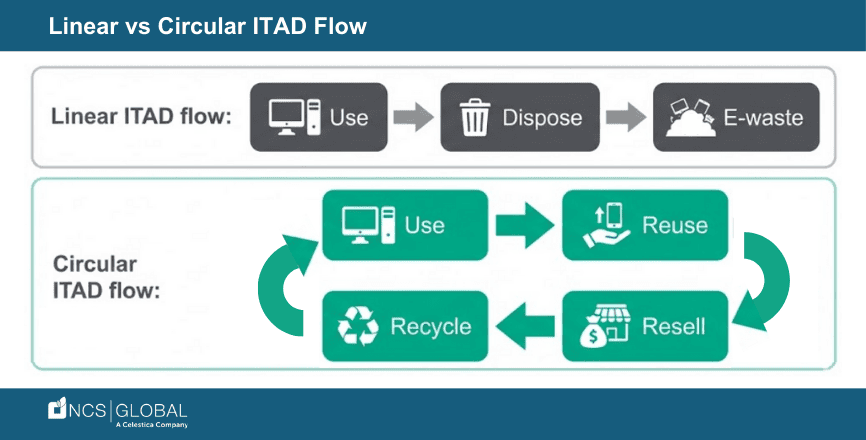
Understanding the Linear vs. Circular ITAD Model
Most traditional ITAD programs follow a familiar linear pattern:
- Procure hardware
- Use hardware
- Decommission hardware
- Discard or bulk-recycle hardware
That linear path maximizes e-waste and minimizes value recovery. It also increases the risk that assets are rushed off-site without proper tracking or certified data destruction.
In a circular ITAD model, assets follow a more intentional and controlled path:
- Procure with lifecycle and reuse in mind
- Use and maintain assets for as long as they remain secure and performant
- Reuse, repair, and redeploy assets internally when possible
- Resell viable equipment into secondary markets to recover value
- Recycle only when assets truly reach end-of-life, and do so through certified, responsible channels
This circular IT asset disposition approach dramatically reduces waste and stretches the usable life and value of your hardware without sacrificing security or compliance.
Why ITAD Circularity Matters
IT leaders are under pressure to do more with less: reduce spend, meet aggressive ESG targets, and prove that every retired asset is handled securely and compliantly.
A circular ITAD strategy helps on all fronts:
Cost savings and value recovery
Instead of treating retired IT assets purely as waste, circular IT asset disposition treats them as recoverable value. Assets that still have market life left can be refurbished and resold, generating revenue that offsets new procurement.
Extended asset life
Circular ITAD is tightly connected to lifecycle management. With the right repair and out-of-warranty support, many enterprise systems can be kept in service 2–3 additional years, delaying expensive refresh cycles while maintaining performance and compliance.
Reduced environmental impact and stronger ESG performance
Every asset that is reused or resold instead of scrapped reduces e-waste, conserves natural resources, and lowers your organization’s carbon footprint. That’s a tangible, reportable contribution to your ESG commitments.
Risk reduction across the secure IT asset lifecycle
Circularity doesn’t mean keeping old hardware around unsecured. It means pairing reuse and resale with:
- Certified data erasure or destruction
- Chain-of-custody documentation
- Compliance with regulations such as GDPR, HIPAA, and e-waste rules
When handled properly, circular ITAD reduces risk by creating standardized, auditable processes for every asset from deployment to final disposition.
How Circularity Works in Practice
So what does circularity in ITAD look like when it’s actually implemented? Let’s walk through it using NCS Global’s circular, secure IT asset lifecycle services as the model.
Secure data destruction via EcoErase
Before any asset can be reused, resold, or recycled, its data must be irreversibly destroyed.
NCS Global uses EcoErase, our proprietary data erasure software, to securely wipe data on hard drives and other storage media. EcoErase can be deployed on-site, supports multiple wipe passes, and is compliant with NIST and DoD data destruction standards. Where required, we also provide degaussing and physical destruction.
This ensures that circularity never compromises data security.
Value recovery through resale
Once data is securely removed, assets are tested, graded, and prepared for resale. NCS Global taps into secondary markets to maximize return on still-viable equipment and shares that revenue with the customer, directly improving the economics of your ITAD program.
Out-of-warranty repair and lifecycle management
Some hardware is more valuable in your own environment than on the resale market. NCS Global’s Lifecycle Management and Out-of-Warranty Parts Management services help you keep enterprise storage and other critical systems running longer.
By focusing on repair, reuse, and redeployment, these services are designed to:
- Reduce procurement and maintenance costs by up to 30%
- Extend asset life by 2–3 years
- Decrease environmental impact
Certified recycling for end-of-life equipment
Finally, assets that truly can’t be reused or resold are processed through certified e-waste recycling channels. NCS prioritizes compliant, environmentally responsible recycling that meets or exceeds relevant standards and regulations.
In short, circularity in ITAD isn’t a theory. It’s a practical, step-by-step process that you can implement today with the right partner.
Choosing a Circular ITAD Partner
Not every ITAD provider is built for circularity. If you’re serious about sustainable ITAD practices, here’s what to look for.
Certified, auditable processes
Your ITAD partner should hold and follow recognized certifications for both data destruction and e-waste recycling, such as e-Stewards or comparable standards. They should provide detailed certificates of data destruction and documented chain-of-custody reporting.
Transparent reporting on sustainability and compliance
Circular ITAD is only as good as the data you can prove. Look for:
- Asset-level tracking
- Clear reporting on reuse, resale, and recycling rates
- Metrics that feed into your ESG and sustainability reporting
NCS Global provides sustainability metrics and auditable documentation that show exactly how each asset was processed and how much material avoided landfill.
End-to-end service: logistics, destruction, value recovery
Managing circular IT asset disposition across multiple vendors increases risk and complexity. A strong partner should handle:
- On-site pickup and secure logistics
- Data erasure or destruction (on-site or off-site)
- Testing, repair, and refurbishment
- Resale and revenue sharing
- Certified recycling for non-viable assets
NCS Global’s reverse logistics and Lifecycle Management Services (LMS) offer exactly this kind of end-to-end, circular approach for large-scale IT platforms.
Proven experience and innovation
Circularity requires both expertise and operational maturity. NCS Global brings:
- 25+ years of experience in compliant, sustainable IT equipment management
- Proprietary EcoErase software for secure, flexible data destruction
- Lifecycle Management Services that prioritize repair, reuse, and redeployment over default disposal
- A customer-first mindset that treats clients as long-term partners, not one-off projects
Bringing It All Together: Make Your ITAD Program Circular
Circularity in IT asset disposition is not just about “being greener.” It’s a smarter, more resilient way to manage the secure IT asset lifecycle from procurement through end-of-life:
- You reduce costs through value recovery and extended asset life.
- You improve ESG performance by minimizing e-waste and maximizing reuse.
- You lower risk with standardized, certified data destruction and transparent reporting.
With its combination of EcoErase-powered data destruction, value recovery services, lifecycle management, and certified recycling, NCS Global is built to help you move beyond linear disposal and embrace truly circular ITAD.
Ready to make your ITAD program more circular, secure, and sustainable? Contact NCS Global today to find out how we can help you build a circular IT asset disposition strategy that delivers measurable business, security, and sustainability outcomes.